
Hanoi essentials
Do You Need a Visa for Vietnam? E-Visa and 45-Day Exemptions (2026)
Who needs a visa for Vietnam, the 24 countries that are visa-free for 45 days, and how to apply for the 90-day e-visa on the official portal without paying a scam site.
Quick answer
Whether you need a visa depends on your passport, not your tour. Citizens of 24 countries enter visa-free for up to 45 days; everyone else applies online for a 90-day e-visa (US$25) at the one official site, evisa.gov.vn. Allow a few working days, print it, and ignore the look-alike sites that charge more.
On this page
- The short version
- Do you need a visa for Vietnam in 2026?
- Visa exemption vs e-visa: which one is yours
- The 45-day visa exemption, country by country
- The 90-day e-visa: step by step on the official portal
- Avoiding fake visa websites
- Entry points and arriving at Noi Bai
- Staying longer and avoiding overstay
- Before you fly: your checklist
- What this means for your tour with us
- Related tours
- FAQ
- Sources
The short version
Whether you need a visa for Vietnam depends only on your passport, not on which tours you book. Citizens of 24 countries can enter visa-free for up to 45 days. Everyone else applies online for an e-visa before flying – valid 90 days, from one official government website, for US$25. You arrange it yourself; a tour booking has nothing to do with it, and no legitimate tour company or hotel needs to “process” your visa.
- From one of the 24 visa-free countries? Bring a passport valid for at least six months. No paperwork, no fee.
- From anywhere else? Apply for the 90-day e-visa at evisa.gov.vn – the only official site.
- Staying longer than 45 days, or entering more than once? Use the e-visa, even if your country is visa-free.
- Flying in? Carry your printed e-visa and a return or onward ticket – airlines often check both at the gate.
Do you need a visa for Vietnam in 2026?
There are three situations. Find yours below, then read the matching section.
| Your passport | What you can do | What to do first |
|---|---|---|
| One of the 24 visa-free countries (listed below) | Enter and stay up to 45 days | Nothing in advance – just a passport valid for six months |
| Any other country | You need a visa before you travel | Apply for the 90-day e-visa at evisa.gov.vn |
| An ASEAN member (Thailand, Malaysia, Singapore, Indonesia, Laos, Cambodia, the Philippines, Brunei, Myanmar) | Short visa-free stays under separate agreements | Check the exact number of days for your country on the official portal |
Visa exemption vs e-visa: which one is yours
These are the two routes most visitors use. The visa exemption is automatic for eligible nationalities; the e-visa is an online application open to everyone.
| 45-day visa exemption | 90-day e-visa | |
|---|---|---|
| Who it is for | Citizens of 24 listed countries | All nationalities, including those not exempt |
| Length of stay | Up to 45 days | Up to 90 days |
| Cost | Free | US$25 single entry / US$50 multiple entry |
| Paperwork before travel | None | Online application at evisa.gov.vn |
| Entries | Each entry starts a new 45-day stay | Single or multiple, as you choose |
| Best for | Short trips from eligible countries | Longer trips, non-exempt nationalities, or re-entry |
If you are from a visa-free country but plan to stay longer than 45 days, or to leave Vietnam and come back during the same trip, apply for the e-visa instead – it is simpler than counting days at the border.
The 45-day visa exemption, country by country
Vietnam currently waives visas for citizens of 24 countries, under two separate government resolutions. Both allow a stay of up to 45 days, counted from your date of arrival.
Group 1 – unilateral exemption (Resolution 44/NQ-CP)
In force from 15 March 2025 to 14 March 2028, regardless of passport type or reason for travel:
Germany, France, Italy, Spain, the United Kingdom, Russia, Japan, South Korea, Denmark, Sweden, Norway and Finland.
Group 2 – tourism stimulus programme (Resolution 229/NQ-CP)
In force from 15 August 2025 to 14 August 2028, for tourism:
Belgium, Bulgaria, Croatia, the Czech Republic, Hungary, Luxembourg, the Netherlands, Poland, Romania, Slovakia, Slovenia and Switzerland.
Don’t trust old lists. The 2025 tourism programme added twelve European countries – among them Switzerland, the Netherlands, Poland and the Czech Republic – that older guides still say need a visa. If a page tells your European passport to buy an e-visa, check the date on that page before you pay for anything.
Two conditions apply to everyone entering visa-free: your passport must be valid for at least six months, and you may be asked at airline check-in for proof of onward or return travel inside your 45 days.
How the 45 days are counted
Your arrival day counts as day one, whatever time you land, and the 45-day stay runs from there. The exemption covers a single continuous visit; if you leave and come back, the new stay is counted on its own, so travellers planning a side trip to Laos, Cambodia or Thailand and back usually find a multiple-entry e-visa simpler. To stay beyond 45 days in one go, you need the e-visa or another visa – there is no on-the-spot extension of the visa-free period at the airport.
The 90-day e-visa: step by step on the official portal
If your country is not on the list above, or you want to stay longer or enter more than once, Vietnam’s e-visa is open to all nationalities. It is valid for 90 days in single-entry (US$25) and multiple-entry (US$50) versions, and you can do the whole thing yourself in about fifteen minutes.
- Go to the official site, evisa.gov.vn. This is the Vietnam Immigration Department’s own system and the only government portal.
- Upload a passport photo and a scan of your passport bio page. Plain light background for the photo, no glasses; the whole bio page, including the two lines of code at the bottom, must be readable.
- Enter your details exactly as they appear in your passport – see the name-order note below.
- Choose single or multiple entry and pick your entry point. For Hanoi that is Noi Bai International Airport (HAN).
- Pay the US$25 or US$50 fee by card and save your registration code. You need it to check the result and to download the visa.
- Download and print the e-visa when it is approved. Keep a photo on your phone as a backup.
How much it costs and how long it takes
The official fee is US$25 for single entry and US$50 for multiple entry, paid by card on the portal. Processing usually takes about three working days, but allow longer in busy periods and never leave it to the last day. The fee is not refunded if an application is refused, so check every field before you pay.
Single or multiple entry – which to choose
Single entry (US$25) is enough for a straightforward trip: you fly in, travel around Vietnam, and fly out once. Choose multiple entry (US$50) only if you will leave the country and come back during the same trip – for example a side trip to Laos, Cambodia or Thailand before returning to fly home from Hanoi. A domestic flight between Hanoi, Da Nang or Ho Chi Minh City does not count as leaving the country, so it does not need multiple entry.
What you need to apply
- A passport valid for at least six months with two blank pages
- A clear scan or photo of the passport bio page
- A passport-style portrait photo, plain background, no glasses
- Your planned entry date and entry point (Noi Bai for Hanoi)
- A card to pay the US$25 or US$50 fee
Children and families
A child travelling on their own passport needs their own e-visa, applied for separately and at the same fee. A child recorded on a parent’s passport is included in that parent’s application. Everyone, including infants, needs either a visa-free nationality or a valid visa to enter.
Avoiding fake visa websites
Search “Vietnam e-visa” and you will see a row of polished websites with official-looking names and government-style seals. Most are agencies that charge US$60–150 for the same e-visa you can get yourself for US$25, and a few are outright scams. There is only one official site: evisa.gov.vn.
- The official fee is US$25 or US$50, paid by card on evisa.gov.vn
- Be wary of any site charging much more, or adding a “service” or “express” fee
- Avoid sites that ask you to pay by bank transfer or that promise a visa “in one hour”
- No tour company or hotel needs your passport to “arrange” a tourist visa – treat such offers the same way
Entry points and arriving at Noi Bai
When you apply you choose your entry point, and the e-visa is valid at Vietnam’s designated international checkpoints – by air, land or sea. For Hanoi that is Noi Bai International Airport (HAN). At Noi Bai’s Terminal 2 (international arrivals), walk past the “Visa on Arrival” / “Landing Visa” counter – that desk is only for the few travellers who arranged an approval letter in advance. With an e-visa or a visa-free passport you go straight to the immigration queue. Have your passport, your printed e-visa and, if asked, your onward ticket ready, and fill in the arrival card with your first hotel’s address. Once you are through, see our guide to getting from Noi Bai Airport to the Old Quarter and to money and tipping.
Staying longer and avoiding overstay
Overstaying your visa or visa-free period is taken seriously in Vietnam: it can mean a fine when you leave and, in some cases, trouble on future entries. If you want to stay longer than your visa-free 45 days or your e-visa’s 90 days, sort it out before your current permission runs out. For most travellers the simplest route is to apply for the 90-day e-visa in the first place, or to plan a border hop and a fresh entry. Count your days from your arrival date and keep a little buffer before your flight out.
Before you fly: your checklist
- Passport valid for at least six months, with two blank pages
- Your printed e-visa, if you applied for one (plus a photo on your phone)
- A return or onward flight booking, in case the airline asks at check-in
- Your first hotel’s name and address, for the immigration arrival card
- A card or a little cash for anything on arrival (a SIM, a taxi or the airport bus)
The name-order trap. Type your names exactly as printed in your passport, in the same order. A surname and given name swapped round is the single most common reason an e-visa is questioned at the border.
What this means for your tour with us
None of our Hanoi or Sapa tours need a visa of their own, and we never ask for your passport to “arrange” one – your entry visa is strictly between you and Vietnamese immigration. Once you have landed and cleared immigration, booking a tour is simple: see how booking, payment and date changes work, and what to wear and bring on the day.
Tours this guide helps with

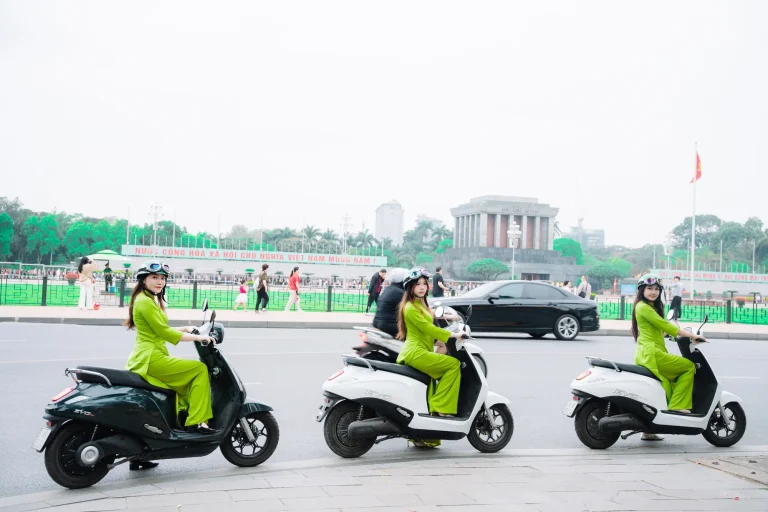
Hanoi · Electric Scooter
Hanoi Half-Day City Tour with Female Riders
876+ booked
From $62
$53
per adult
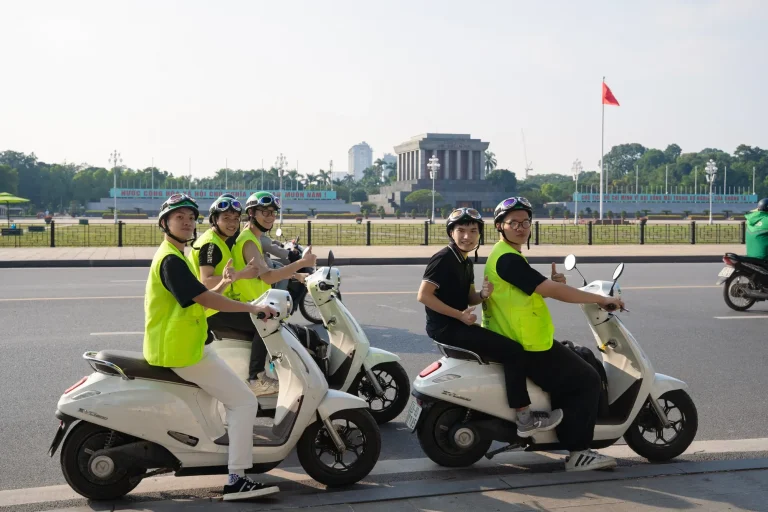
Hanoi · Electric Scooter
Hanoi Half-Day Electric Scooter City Tour
463+ booked
From $60
$51
per adult
Frequently asked questions
Which countries are visa-free for Vietnam in 2026?
Citizens of 24 countries can enter visa-free for up to 45 days. Twelve are covered by Resolution 44/NQ-CP (Germany, France, Italy, Spain, the UK, Russia, Japan, South Korea, Denmark, Sweden, Norway and Finland) until 14 March 2028, and twelve more by the 2025 tourism programme, Resolution 229/NQ-CP (Belgium, Bulgaria, Croatia, the Czech Republic, Hungary, Luxembourg, the Netherlands, Poland, Romania, Slovakia, Slovenia and Switzerland) until 14 August 2028. Your passport must be valid for at least six months.
Do British, German, French, Swiss or Dutch citizens need a visa for Vietnam?
No. All five are on the 45-day visa-free list, so you can enter and stay up to 45 days with no paperwork or fee. The UK, Germany and France are covered by Resolution 44/NQ-CP; Switzerland and the Netherlands were added by the 2025 tourism programme. Apply for an e-visa only if you plan to stay longer than 45 days or to enter more than once.
Do US, Australian, Canadian or Indian citizens need a visa for Vietnam?
Yes. These countries are not on the visa-free list, so you apply online for the 90-day e-visa before you travel. It costs US$25 for single entry or US$50 for multiple entry and is open to all nationalities at evisa.gov.vn.
What is the official Vietnam e-visa website?
There is one official site only: evisa.gov.vn, run by the Vietnam Immigration Department. Everything else in a search is an agency or a scam. The official fee is US$25 (single entry) or US$50 (multiple entry); if a site charges much more, it is not the government.
How much does the Vietnam e-visa cost and how long does it take?
The 90-day e-visa costs US$25 for single entry or US$50 for multiple entry, paid by card on the official portal. Processing usually takes about three working days, but it can take longer in busy periods, so apply at least a week before you fly.
Do I need single or multiple entry?
Single entry (US$25) is enough if you fly in, travel around Vietnam and fly out once. Choose multiple entry (US$50) only if you will leave the country and return during the same trip, such as a side trip to Laos, Cambodia or Thailand. Domestic flights within Vietnam do not count as leaving.
How long can I stay in Vietnam, and what if I want to stay longer?
The visa exemption allows up to 45 days from your arrival date, and the e-visa up to 90 days. To stay longer, apply for the 90-day e-visa from the start, or plan a border hop and a fresh entry. Sort any extension out before your current permission expires.
Can I still get a visa on arrival at Noi Bai Airport?
For almost all travellers the online e-visa has replaced visa on arrival. A true visa on arrival still exists but needs an approval letter arranged before you fly, so unless you have a specific reason, apply for the e-visa and arrive with it printed. At Noi Bai, skip the Visa on Arrival counter and go straight to immigration.
Is the e-visa valid at Noi Bai Airport and at land borders?
Yes. You choose your entry point when you apply, and the e-visa is valid at Vietnam's designated international checkpoints by air, land and sea, including Noi Bai International Airport (HAN) for Hanoi. Enter at the point you selected, or check the portal if your plans change.
Do children need their own visa?
A child travelling on their own passport needs their own e-visa at the same fee, or a visa-free nationality. A child recorded on a parent's passport is included in the parent's application. Everyone, including infants, needs a visa or a visa-free passport to enter.
What happens if I overstay my visa in Vietnam?
Overstaying is taken seriously and can mean a fine when you leave, and in some cases difficulties on future entries. Count your days from your arrival date, keep a buffer before your flight out, and if you need longer, arrange it before your current permission expires.
Does booking a tour help with my visa?
No, and it should not have to. Your visa is between you and Vietnamese immigration. We never ask for your passport to process a visa, and you should be wary of any tour or hotel that offers to do so for a fee.
Sources
We check facts against these sources. Rules and prices change, so confirm anything important with the official source before you travel.
- Resolution 44/NQ-CP (2025) – 45-day visa exemption for 12 countries, valid 15 March 2025 to 14 March 2028 (LuatVietnam, English translation) (as of Oct 2026)
- Resolution 229/NQ-CP – Tourism Development Stimulus Programme visa exemption for 12 countries, 15 August 2025 to 14 August 2028 (Embassy of Vietnam in Japan) (as of Oct 2026)
- Vietnam National Electronic Visa portal – official e-visa application and fees (Vietnam Immigration Department) (as of Oct 2026)
- Visa policy of Vietnam – overview of exemptions and e-visa, cross-referenced with the resolutions above (as of Oct 2026)
Spotted something out of date? Tell us on WhatsApp