
On an Eco Trip Asia tour
What to Wear on a Hanoi Tour: Seasons, Temple Dress Codes and a Day-Bag Checklist (2026)
What to wear in Hanoi by season, temple and Mausoleum dress codes, what works on each type of tour, the ao dai option, and a day-bag checklist.
Quick answer
Dress for a warm, humid city where you sit in an open vehicle or on a scooter, step into a pagoda and eat on low stools: loose, breathable clothes that cover your shoulders and knees, and shoes that stay on your feet. Helmets and rain ponchos are provided on our tours, so you do not need to pack them. Add a windproof layer in winter for the wind on a moving vehicle.
On this page
The short version
If you only read one paragraph: dress for a warm, humid city where you will sit in an open vehicle or on the back of a scooter, step into a pagoda courtyard and eat at low plastic stools. In practice that means loose, breathable clothes that cover your shoulders and knees, and shoes that stay on your feet. Everything else depends on the tour and the month.
- Breathable top that covers your shoulders (a T-shirt is fine)
- Trousers, a midi skirt or shorts that reach the knee
- Closed shoes or sturdy sandals with a back strap
- A light layer (shirt, cardigan or thin jacket) for winter mornings and air-conditioned cafés
- Sunglasses, sunscreen and a small bottle of water
- A hair tie if you have long hair – helmets and wind make loose hair hard work
You do not need to bring a helmet: helmets are provided on all scooter, motorbike, e-bike and ATV tours, and on Instagram tours if you choose the motorbike. Rain ponchos are provided on all our tours, in Hanoi and Sapa, whenever it rains.
What to wear on each type of tour
Vintage jeep tours
Our army jeeps are open-air, so you feel the sun, the breeze and any drizzle. You sit for most of the tour and hop out at photo stops, so comfort matters more than anything technical. Avoid very short skirts (you climb in and out several times) and bring sunglasses – the wind can carry dust on busy roads. A cap is fine in the jeep but may blow off when the car is moving, so keep it in your lap on faster stretches.
On full-day trips out of the city, such as the Ba Vi National Park & Duong Lam jeep tour, wear comfortable shoes for short walks in the park and village, and bring a light jacket: mountain weather there is cooler than in Hanoi.
Electric scooter and female-rider tours
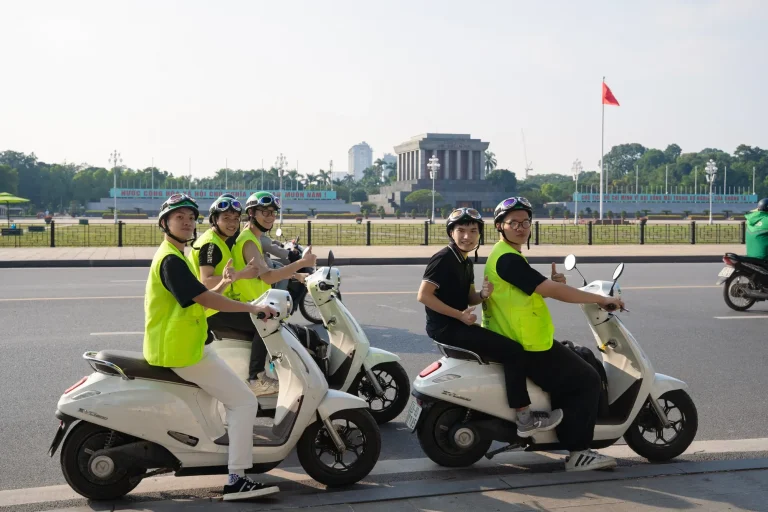
You ride as a passenger behind a professional local rider, one guest per rider, and you wear a helmet throughout. That shapes what works:
- Trousers or knee-length shorts are easiest to sit in. Long, flowing skirts and wide scarves can flap towards the wheel – tuck them in or leave them at the hotel.
- Shoes that stay on. Trainers or sandals with a heel strap. Flip-flops tend to slip off when you get on and off.
- No big hat. It will not fit under the helmet. A hair tie and sunscreen do the job instead.
- A thin long-sleeved layer on sunny days protects your arms from the sun while you ride.
Self-ride e-bike and ATV tours
These are the two tours where you are in control. On the ATV tour in the pine forest, wear closed shoes and clothes you do not mind getting dusty – this comes straight from our tour notes. A helmet and safety equipment are provided. On the e-bike tours, wear something you can pedal in comfortably (nothing that catches on the chain), flat closed shoes and sun protection; helmets are included.
Street food tours
Hanoi street food is eaten on small stools, often on the pavement. Wear something you are relaxed sitting low in, and avoid white tops if you are worried about broth splashes. Loose waistbands are a genuine tip, not a joke. Food tours run in the morning and in the evening on the same route; on evening tours in winter bring the light layer.
Instagram and photo tours
Plan your outfit around your photos – but still pick something you can sit in, in a jeep, a limo or on a motorbike. Bold, solid colours tend to read well in photos of busy streets. If you want to wear an ao dai, see the section below.
Dressing for Hanoi’s seasons
Hanoi has real seasons, which surprises many visitors who expect year-round tropical heat. Long-term averages for central Hanoi (Lang station, 1991–2020) give a good guide:
| Season | What it feels like | What to wear |
|---|---|---|
| Summer (May–September) | Hot and humid, the wettest months. Average daytime highs are around 32–35 °C from May to August. | The lightest clothes you own, a thin long-sleeved layer for sun, sunscreen. Expect sudden showers – ponchos are included on all our tours. |
| Autumn (October–November) | Temperatures and rain drop. Average highs fall from about 30 °C in October to about 27 °C in November. | Summer clothes by day; a light layer for early starts and evenings. |
| Winter (December–February) | Cool and often grey. Average lows are around 14 °C in December and January, with spells of drizzle. | Long trousers, a jumper or fleece and a windproof jacket – the jeep and scooter make it feel colder. |
| Spring (March–April) | Drizzly, damp and humid, with little sunshine early in the season. | Layers, quick-drying fabrics and shoes that cope with wet pavements. |
For month-by-month detail, see our Hanoi weather by month guide.
Local tip: on winter jeep and scooter tours, the wind chill catches people out more than the temperature. If you are packing light, one windproof layer is worth more than a thick jumper.
Covering up for pagodas and temples
Several of our routes stop at pagodas and temples, such as Tran Quoc Pagoda on West Lake. Vietnam’s official tourism site asks visitors to dress modestly at religious sites, to cover shoulders and knees, and to remove shoes and hats when entering a temple building. Even on tours that only stop outside for photos, it is respectful – and easier – to dress this way from the start.
- Shoulders covered: a T-shirt, or a scarf or shirt you can throw on
- Knees covered: trousers, a midi skirt or long shorts
- Shoes easy to slip off if you go inside a building
- Hat off when you go in; speak quietly
If you plan to visit the Ho Chi Minh Mausoleum on your own, note that in 2026 it is closed for annual maintenance from 4 September to 2 November and reopens on 3 November 2026. It normally closes on Mondays and Fridays. Dress rules there are stricter than at pagodas – sources differ, but at minimum cover shoulders and knees, and expect to remove hats and sunglasses. See our Hanoi etiquette and dress code guide for more.
Ao dai photos: how to make the most of it
The ao dai – the long tunic worn over trousers – photographs beautifully against Hanoi’s old streets, and there are several ways to include one in your tour:
| Option | Where | Cost |
|---|---|---|
| Female guide in a traditional ao dai | Hanoi jeep tours (tick it when you book) | US$5 per person |
| Ride with a female rider in an ao dai | Hanoi Instagram city tour and Mega Grand World tour | US$5 per person |
| Female riders and guides in ao dai | Green Sisters (female rider) tours | Part of the tour |
| Rent your own ao dai at a local boutique before the tour | Instagram tours | Small fee, paid on site |
Tips if you are wearing one yourself:
- Book an Instagram tour if the outfit is the point – you can add the optional ao dai rental stop, and the guide is happy to take photos on your phone or camera all the way round.
- Choose your light. Morning departures give softer light and quieter streets; late-afternoon departures give golden hour.
- Pick the vehicle for the outfit. The jeep is the most iconic backdrop, the limo the most comfortable in heat or rain. If you choose the motorbike, a helmet is provided – ask your rider how best to sit with the side panels gathered.
- Bring flat shoes and keep heels for posed shots only.
- Add the Fujifilm retro camera (US$5 per person) on Instagram tours if you want a printed Instax photo to take home.
On our tours: Green Sisters riders wear the ao dai, and on Sapa tours our guides wear their own ethnic dress. Guests often ask to photograph them – just ask first, and they are usually delighted.
What to bring in your day bag
Keep it small. On a scooter you will wear it on your back or in your lap; in a jeep it sits by your feet. A cross-body bag worn in front is ideal.
- Phone with WhatsApp and your booking reference
- Cash for the balance of your tour (paid on the tour day), plus some Vietnamese dong for drinks and small purchases
- Sunscreen and sunglasses
- Insect repellent – dengue occurs in Hanoi year-round
- A small bottle of water (bottled water is included on many tours – check yours)
- Tissues and hand sanitiser for street-food stops
- Any medicines you need, especially for allergies
- A light layer from November to April
Check your tour page for the cash balance and what is included. Tips for your guide and driver are optional and not included.
What to leave at the hotel
- Large backpacks and luggage. There is little space on a scooter and limited space in a jeep shared by up to six guests.
- Valuables you would hate to lose. Bag-snatching from motorbikes happens in crowded tourist areas, so carry less and keep your bag on the side away from traffic.
- Your own umbrella on scooter tours – it is no use on a moving bike. Ponchos work better and we provide them.
Tours this guide helps with


Hanoi · Instagram & Photo
Hanoi Instagram Tour: City Highlights by Jeep, Limo or Motorbike
397+ booked
From $72
$60
per adult
Hanoi · Electric Scooter
Hanoi Half-Day Electric Scooter City Tour
463+ booked
From $60
$51
per adult
Frequently asked questions
What should I wear on a Hanoi tour?
Loose, breathable clothes that cover your shoulders and knees, and shoes that stay on your feet (trainers or sandals with a back strap). Add sunglasses, sunscreen and a hair tie, and a light windproof layer in winter. You do not need to bring a helmet or rain poncho – both are provided on our tours.
Do I need to bring my own helmet for a scooter or motorbike tour?
No. Helmets are provided on all scooter, motorbike, e-bike and ATV tours, and on Instagram tours if you choose the motorbike. Rain ponchos are provided on all our tours, in Hanoi and Sapa, whenever it rains.
What should I wear to temples and pagodas in Hanoi?
Cover your shoulders and knees, and be ready to remove your shoes and hat when entering a temple building. A T-shirt with trousers, a midi skirt or long shorts is fine; carry a light scarf or shirt you can throw on. Even on tours that only stop outside, it is easier to dress this way from the start.
What is the dress code for the Ho Chi Minh Mausoleum?
Dress rules there are stricter than at pagodas: cover your shoulders and knees, and expect to remove hats and sunglasses and to leave bags and cameras at security. Note that in 2026 the Mausoleum is closed for annual maintenance from 4 September to 2 November, reopening on 3 November, and it normally closes on Mondays and Fridays.
What should I wear on a scooter or motorbike tour?
Trousers or knee-length shorts are easiest to sit in; avoid long, flowing skirts and wide scarves that can flap towards the wheel. Wear shoes that stay on (trainers or sandals with a heel strap, not flip-flops), skip the big hat because it will not fit under the helmet, and bring a thin long-sleeved layer for sun.
Can I wear an ao dai on a Hanoi tour?
Yes. You can add a female guide or rider in a traditional ao dai on jeep and Instagram tours for US$5 per person, rent your own ao dai at a boutique before an Instagram tour, or join a Green Sisters female-rider tour where the riders wear ao dai. Bring flat shoes and keep heels for posed photos.
What should I wear in Hanoi in winter?
Long trousers, a jumper or fleece and a windproof jacket. Winter highs are only around 20–22°C and the wind chill on an open jeep or a scooter catches people out more than the temperature – one windproof layer is worth more than a thick jumper.
What should I bring in my day bag?
Your phone with WhatsApp and booking reference, cash for the tour balance plus small notes, sunscreen and sunglasses, insect repellent, a small water bottle, tissues and hand sanitiser for street-food stops, any medicines you need, and a light layer from November to April. A cross-body bag worn in front is ideal on a scooter.
Do your tours provide rain gear?
Yes. Rain ponchos are provided on all our tours, in Hanoi and Sapa, whenever it rains, and your guide may reorder stops to keep you dry. There is no need to pack a poncho or, on scooter tours, an umbrella – an umbrella is no use on a moving bike.
What shoes should I wear in Hanoi?
Closed shoes or sturdy sandals with a back strap. Pavements are uneven and often full of parked motorbikes, and on scooter tours flip-flops tend to slip off when you get on and off. On the ATV tour and countryside e-bike tours, wear closed shoes you do not mind getting dusty or muddy.
Sources
We check facts against these sources. Rules and prices change, so confirm anything important with the official source before you travel.
Spotted something out of date? Tell us on WhatsApp