Chuong Conical Hat Village
Chuong village, south of Hanoi, where families have hand-made Vietnam’s iconic conical hats for centuries and hold an early-morning hat market.
- Hanoi
- Included in 1 tour
- Tours from $65
- Updated October 2026

About the Conical Hat Village in Hanoi
When people search for a conical hat village in Hanoi, they usually mean Chuong village (lang Chuong) in the Thanh Oai area, about 30 km south of the city centre. For centuries, families here have made the non la — the leaf hat that has become a symbol of Vietnam — and the village is still one of the best-known hat-making centres in the north.
Walk through the lanes on a normal day and you will see women and older villagers sitting in doorways and courtyards, shaping frames, laying leaves and stitching hats by hand. Hats are sold to markets across the country and to souvenir shops in Hanoi.
The Chuong hat market
Chuong is also known for its market, held six times a month on the lunar calendar — on the 4th, 10th, 14th, 20th, 24th and 30th days. From around dawn, villagers bring stacks of finished hats, leaves, bamboo rings and thread to the market yard to trade. It is busy, white with hats, and mostly over by mid-morning, so arrive early if you want to see it.
How non la hats are made
Palm leaves are brought from central Vietnam, then sun-dried, flattened and ironed until they are pale and smooth. Thin bamboo is shaped into a set of graded rings that form the cone. Leaves are laid in layers over the frame, and the hat is stitched by hand with fine thread, ring by ring. A good hat takes skill and patience, and some makers add hidden pictures or poems between the layers that show when you hold the hat up to the light.
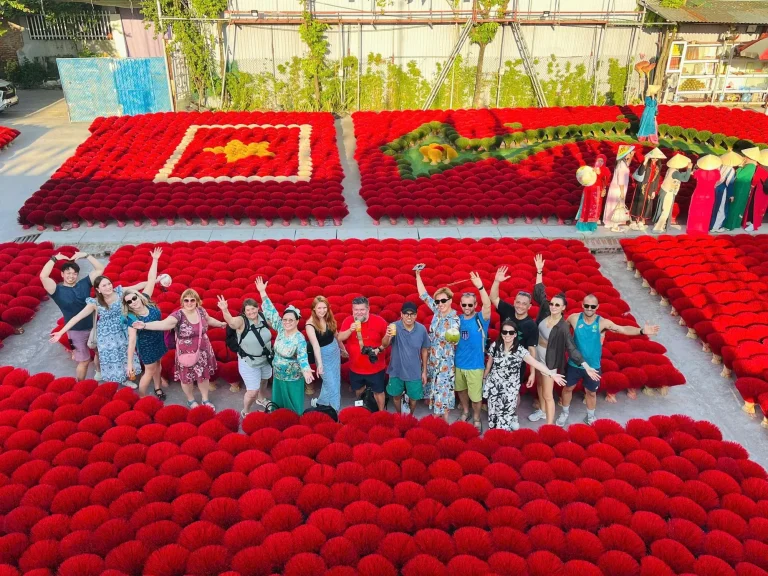
Our Quang Phu Cau Instagram tour stops at the nearby conical hat village after the incense yards, so you can watch craftsmen weave non la hats and learn their history.
Is the conical hat village worth visiting?
Yes, if you enjoy traditional crafts. In Chuong village you can watch women and older villagers shape bamboo frames, lay palm leaves and stitch the non la by hand in their courtyards – the leaf hat that has become a symbol of Vietnam. It is at its most atmospheric at dawn on a market day, when the yard turns white with stacks of finished hats, and it combines well with the nearby incense village.
Worth it?
Why visit Chuong Conical Hat Village?
- Centuries of hat makingOne of northern Vietnam’s best-known conical hat villages.
- Hand stitching up closeWatch makers work in their homes and courtyards.
- The lunar hat marketSix market days a month, white with stacks of hats.
- Hidden picturesSome hats hold patterns or poems visible against the light.
- Easy to combineAbout half an hour from Quang Phu Cau incense village.
Make the most of it
9 best things to do in Chuong Conical Hat Village
Visit the hat market
On the 4th, 10th, 14th, 20th, 24th and 30th of each lunar month, from around dawn. Check a lunar calendar before you go; it is quiet by mid-morning.
Watch hats being made
Ask your guide to introduce you to a family workshop to see leaves ironed, rings shaped and hats stitched.
Try a few stitches
Some makers let visitors try. It is harder than it looks.
Buy a hat from the maker
Simple hats cost from about 30,000–80,000 VND; finer ones with hidden pictures cost more.
Hold a hat up to the light
Look for the patterns or verses hidden between layers.
Visit with our incense village tour
Our Instagram tour adds the conical hat village after Quang Phu Cau, by jeep or green limo.
Learn the leaf preparation
Ask to see how palm leaves are ironed flat over a heated pan with a cloth pad — a step that decides how smooth and pale the finished hat will be.
Compare hat styles
Besides the everyday non la, look for thinner, finer hats, children’s sizes and small souvenir hats. Makers can explain what makes a hat last for years.
Walk to the communal house
Like most northern villages, Chuong has a communal house and pagoda near the centre; quiet places to rest between workshops. Dress modestly.
Good to know
Process: how a conical hat is made
| 1. Leaves | Palm leaves from central Vietnam are dried and flattened |
|---|---|
| 2. Ironing | Leaves are ironed until smooth and pale |
| 3. Frame | Thin bamboo is shaped into graded rings |
| 4. Layering | Leaves are laid in layers over the frame |
| 5. Stitching | The hat is sewn by hand, ring by ring |
| 6. Finishing | Some hats get a varnish, pictures or a chin strap |
Timing
Best time to visit Chuong Conical Hat Village
The 4th, 10th, 14th, 20th, 24th and 30th of the lunar month, from dawn to about mid-morning.
Makers are at work in their homes and the village is calm.
October to April is the most comfortable; summer is hot with storms.
Many families pause work for the holiday.
If you visit Quang Phu Cau on a sunny day, go to Chuong first on a market morning, then the incense yards later when the colours are brightest.
Map & directions
How to get to Chuong Conical Hat Village
- By car or GrabAbout 30 km, 50–70 minutes from the Old Quarter. Around 350,000–500,000 VND each way.
- By motorbikePossible on main roads; the village lanes are narrow.
- From Quang Phu CauAbout 30 minutes by road, easy to combine in half a day.
- With usOur incense village Instagram tour includes the conical hat village and hotel pickup.
Eat like a local
Where to eat near Chuong Conical Hat Village
- Market snacksOn market days, stalls sell sticky rice, banh duoc and hot drinks.
- Noodle shopsSmall pho and bun shops on the main road nearby.
- Lunch in HanoiThere are few restaurants in the village; most visitors eat in the city.
For your camera
Best photo spots at Chuong Conical Hat Village
- Market yard at dawnStacks of white hats and traders in morning light.
- Makers’ handsClose-ups of stitching — ask first.
- Hats against the lightHidden patterns glowing through the leaves.
- Stacks of leaves in courtyardsPale ironed leaves and bamboo rings drying in the sun.
Local advice
Tips for visiting Chuong Conical Hat Village
Do
- Check the lunar calendar for market days
- Arrive early for the market
- Buy directly from makers
- Ask before photographing people at work
- Carry small notes
Don’t
- Arrive at noon expecting the market
- Touch hats drying on racks
- Bargain too hard for handmade work
- Block lanes with groups
- Fly a drone over the market
Visit with a local
Tours that visit Chuong Conical Hat Village
Hanoi · Instagram & Photo
Quang Phu Cau Incense Village Instagram Tour from Hanoi
459+ booked
From $78
$65
per adult
Good to know
Chuong Conical Hat Village: questions & answers
Where is the conical hat village in Hanoi?
The best-known is Chuong village in the Thanh Oai area, about 30 km south of central Hanoi.
When is the Chuong conical hat market?
Six days a month on the lunar calendar: the 4th, 10th, 14th, 20th, 24th and 30th, from around dawn to mid-morning.
How are Vietnamese conical hats made?
Dried palm leaves are ironed, layered over a frame of bamboo rings and stitched by hand.
How much does a conical hat cost in Chuong village?
Simple hats start from about 30,000–80,000 VND; finer ones with hidden pictures cost more.
Is there an entrance fee for the conical hat village?
No, the village and market are free to visit.
Can I combine the conical hat village and the incense village?
Yes. They are about half an hour apart, and our Instagram tour visits both.
Why do Vietnamese wear conical hats?
The non la protects from both sun and rain, is light and cheap, and can be used as a fan or basket. Farmers and market traders still wear them every day.
Is the conical hat village Hanoi worth visiting?
Yes, if you like crafts and village life. It is small, so it works best combined with Quang Phu Cau incense village in a half-day trip.
What is a non la, the Vietnamese conical hat?
The non la is the palm-leaf conical hat worn across Vietnam and a national symbol. In Chuong village it is made by shaping graded bamboo rings into a cone, layering sun-dried palm leaves over the frame and stitching it by hand, ring by ring; some makers hide pictures or poems between the layers that show in the light.
Is the Chuong conical hat village worth visiting?
Yes, for a short, authentic craft stop about 30 km south of Hanoi. You can watch hats being stitched by hand on any day, and on market days (the 4th, 10th, 14th, 20th, 24th and 30th of the lunar month) the dawn hat market is a memorable sight. It pairs well with the Quang Phu Cau incense village.
Hanoi