

People & culture
What Is Hmong Batik? Beeswax Drawing and Indigo Dyeing in Sapa
How Hmong women draw patterns in molten beeswax, dye the cloth in indigo and boil the wax away – and where to watch the work in the villages around Sapa.
Definition
Hmong batik is a wax-resist technique in which Hmong women draw patterns on hemp cloth with molten beeswax, dye the cloth in indigo and then boil off the wax, leaving pale designs on deep blue. In the villages around Sapa in northern Vietnam, Black Hmong families still make batik and indigo cloth for clothing and textiles.
Vietnamese: vẽ sáp ong và nhuộm chàmAlso called: Hmong batik, beeswax batik, indigo dyeing
At a glance
| Vietnamese name | vẽ sáp ong (batik), nhuộm chàm (indigo dyeing) |
|---|---|
| Materials | Hand-woven hemp cloth, beeswax, indigo dye |
| Tool | Bamboo or wooden pen with a copper tip |
| Wax temperature | Kept at about 70–80°C while drawing |
| Dyeing | Dipped and dried five or six times over several days |
| Where to see it | Cat Cat, Lao Chai and Ta Phin villages near Sapa |
| On our Ta Phin tour | $53 · Black Hmong home visit |
On this page
What is Hmong batik?
Batik is a resist-dyeing method: wax is applied to cloth, the cloth is dyed, and the wax is removed, so the parts that were waxed keep the original colour of the fabric. Many cultures use it, but Hmong batik has its own materials and style. It is drawn with beeswax on hand-woven hemp and dyed with indigo, usually freehand. Around Sapa it is made above all by the Black Hmong, whose deep indigo clothes give the group its name, and it decorates skirts, baby carriers, bags, scarves and other traditional textiles.
From plant to cloth
Traditional batik starts long before the wax. Women grow the fibre plant on their own plots and harvest it after about two months. The stems are stripped, the sheaths pounded in stone mortars until only the tough fibres remain, and the threads are joined by hand, then boiled several times in water with ash and beeswax to make them softer and whiter. The thread is woven on a wooden loom and the cloth washed many times. Much of this work fills the gaps in the farming year, and a woman’s skill was traditionally judged by the cloth she made for her own clothes.
How batik is made, step by step
- Prepare the cloth. The white hemp is soaked in ash water, which whitens it and helps the dye take.
- Melt the wax. Beeswax is melted and kept at about 70–80 °C so that it does not harden on the pen.
- Draw the pattern. The artisan dips a pen with a bamboo or wooden handle and a tip of thin copper blades into the wax and draws straight onto the cloth, usually freehand, without a sketch.
- Dye in indigo. The cloth goes into the indigo vat for about an hour, is drained and dried, and goes back in – five or six times over several days for a deep colour. The waxed lines resist the dye.
- Boil off the wax. The cloth is boiled so the wax melts away, revealing pale patterns on indigo.
- Finish. Coloured embroidery is often added before the cloth is sewn into clothing or household textiles.
Patterns and their meaning
Batik motifs are taken from nature: snails, ferns, leaves, flowers, the sun and the moon. Hmong artisans say the patterns on their clothes and household cloth help them communicate with the gods, invite blessings and ward off evil. The craft is passed from mother to daughter, mostly by watching and practising, and cloth stays important for a whole life: a mother gives her daughter a hemp dress when she marries, and the dead are buried in their own hemp clothes. In Ta Phin commune, Hmong costume-making is on Vietnam’s national list of intangible heritage.
Hmong batik vs Red Dao embroidery
| Hmong batik | Red Dao embroidery | |
|---|---|---|
| Technique | Beeswax drawn on cloth, dyed, wax boiled off | Hand stitching in coloured thread, held without a frame |
| Look | Pale patterns on deep indigo | Dense red-dominated patterns on dark cloth |
| Where near Sapa | Cat Cat, Lao Chai, Black Hmong hamlets of Ta Phin | Ta Phin, Red Dao hamlets around Ta Van |
The two often meet in one village: Ta Phin is known both for Red Dao needlework and for Black Hmong indigo and batik.
Where to see batik and indigo dyeing
- Cat Cat, just below Sapa town: several houses demonstrate spinning, weaving and indigo dyeing, and you can buy directly from the makers.
- Lao Chai, in Muong Hoa Valley: hemp drying in the sun and indigo vats beside the houses; many families will show you how the cloth is made.
- Ta Phin: Black Hmong families work with hemp, indigo and beeswax batik in the hamlets around the Red Dao village.
- In Hanoi: the fashion floor of the Vietnamese Women’s Museum shows the costumes, weaving and embroidery of Vietnam’s 54 ethnic groups.
Buying a small piece from the person who made it is a good way to thank a family for showing you their work.
Batik and indigo on our Sapa tours
On the Ta Phin half-day jeep tour you walk the village paths and visit a Black Hmong family to learn about beeswax batik, indigo dyeing and traditional weaving, before tea with a Red Dao family and a herbal bath; it runs as a group tour from $53. The Sapa Instagram tour by motorbike spends time in Cat Cat among its craft workshops, and the Muong Hoa Valley jeep tour walks through Lao Chai, where Black Hmong families and craft sellers line the path.
Places to see it
 Cat Cat VillageA Black Hmong village of wooden houses, craft workshops and a waterfall, just below Sapa town.
 Lao Chai VillageA Black Hmong village spread across the terraces of Muong Hoa Valley, and the start of Sapa’s favourite…
 Ta Phin VillageA Red Dao and Black Hmong village about 12 km from Sapa, known for its herbal baths, embroidery,…
 Vietnamese Women’s MuseumA modern museum in the French Quarter telling the stories of Vietnamese women in family life, history and…
 Vietnam Museum of EthnologyHanoi’s museum of Vietnam’s 54 ethnic groups, with a Bronze Drum gallery, a garden of full-size village houses…
Related tours
Sapa · Jeep
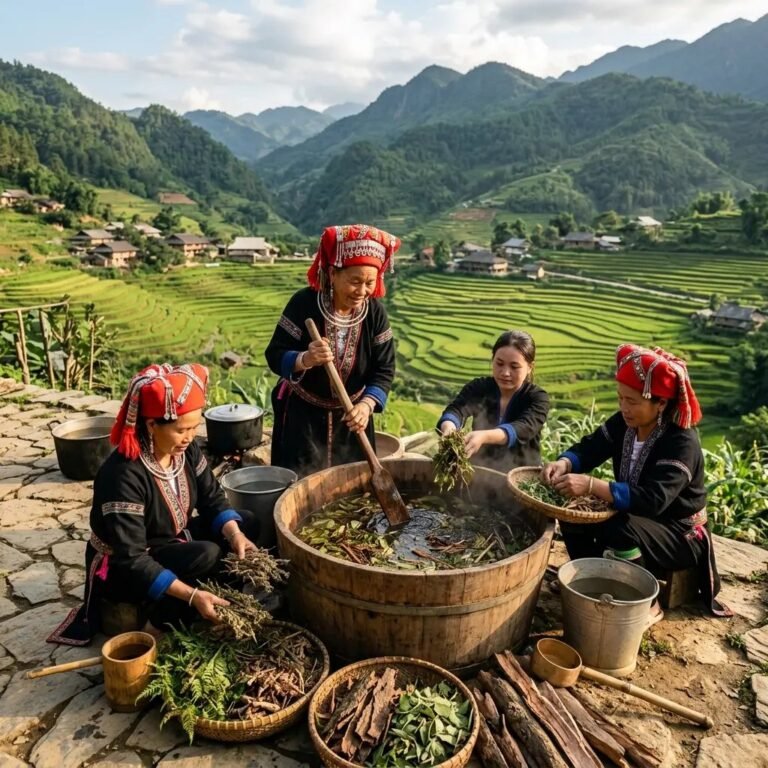
Sapa Half-Day Jeep Tour: Ta Phin Village & Red Dao Herbal Bath
From $53
$50.35
per adult

Sapa · Female Riders
Sapa Instagram Tour by Motorbike: Cat Cat, Moana & Rice Terraces
4.9 (25 reviews)
From $50
$45
per adult

Sapa · Jeep
Sapa Jeep Tour: Muong Hoa Valley, Lao Chai & Ta Van Villages
4.9 (25 reviews)
From $50
$47.50
per adult
Frequently asked questions
What is Hmong batik?
A wax-resist technique: Hmong women draw patterns on hemp cloth with molten beeswax, dye it in indigo and boil the wax off, leaving pale patterns on deep blue.
What tool is used for Hmong batik?
A small pen with a bamboo or wooden handle and a tip made of thin copper blades, dipped in beeswax kept at about 70–80°C.
How many times is the cloth dyed in indigo?
Usually five or six times over several days, with the cloth drained and dried between dips, to reach the deep blue-black of Black Hmong clothing.
What do the batik patterns mean?
Motifs come from nature – snails, ferns, flowers, the sun and moon – and Hmong artisans say they invite blessings and ward off evil.
Where can I see batik being made near Sapa?
In Cat Cat and Lao Chai villages, and in the Black Hmong hamlets of Ta Phin, which our Ta Phin half-day jeep tour visits.
Is batik cloth sold in Sapa?
Yes. Batik cloth, bags and scarves are sold in the villages and around Sapa town; buying directly from the maker supports the family.
Sources
We check facts against these sources. Rules and prices change, so confirm anything important with the official source before you travel.
- Vietnam News – Mông women preserve essence of beeswax painting (12 Oct 2024)
- VietNamNet – Hmong artisan dreams of preserving Vietnam's wax-resist fabric heritage (7 Sep 2025)
- VietNamNet – The craft of linen weaving of the H'Mong people in Lung Tam (23 Jul 2020)
- Wikipedia – Hmong textile art (accessed 29 Nov 2026)
- Báo Lào Cai – Bản sắc văn hóa tạo sức hút riêng cho du lịch Sả Xéng (Tả Phìn) (18 Nov 2026)
Spotted something out of date? Tell us on WhatsApp